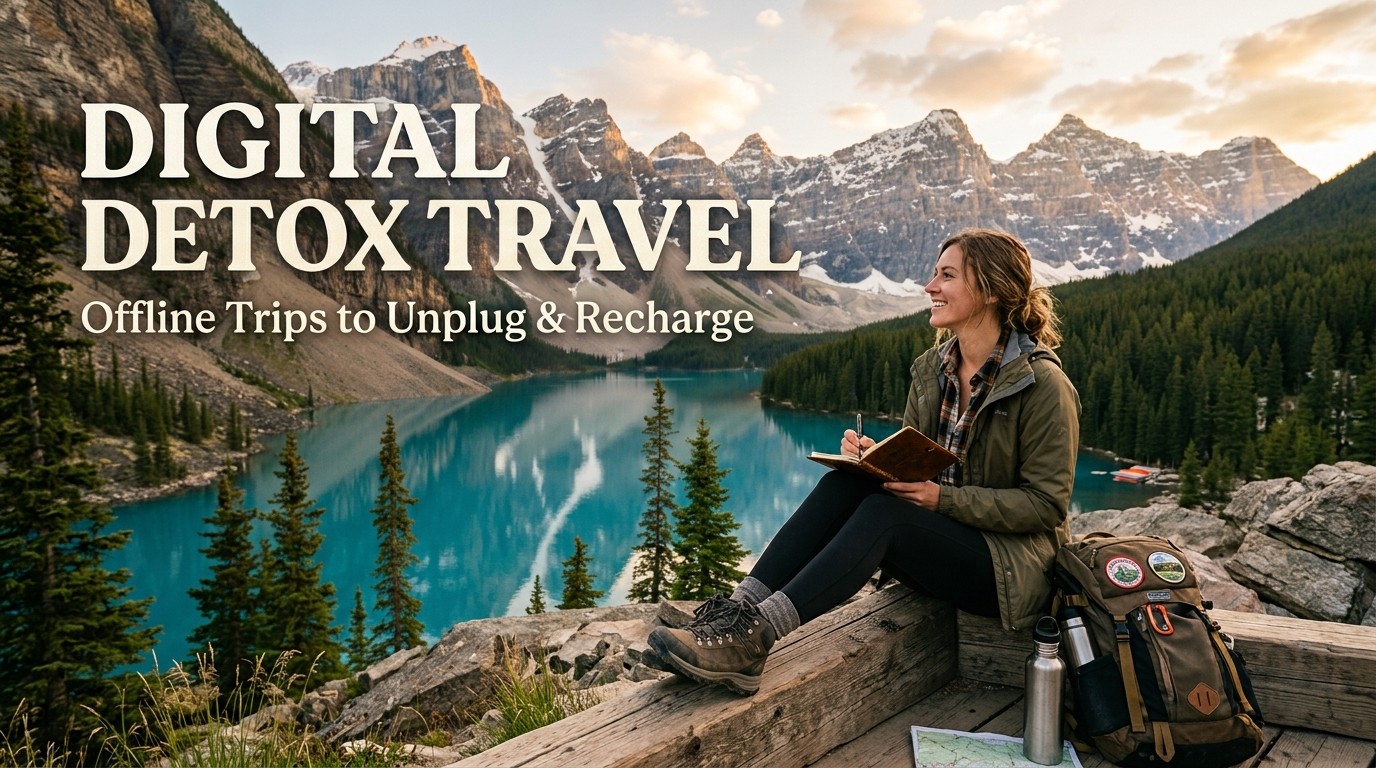
A practical guide to Digital Detox Travel: disconnect from devices, protect attention, recharge mentally, design offline trips, and return home with healthier digital habits for longer.
In a world where phones quietly follow us everywhere, travel can become an extension of the same digital routine we were hoping to escape. You wake up and check notifications, photograph breakfast before tasting it, search every attraction before seeing it, and return to the room to scroll instead of reflecting on the day. The destination changes, but the mental noise stays. This is one of the foundations of Digital Detox Travel.
Digital Detox Travel offers a different approach. Instead of treating a trip as an opportunity to consume more content, you use travel as a chance to reduce stimulation, restore attention, and become more present. The goal is not to reject technology permanently. It is to create intentional periods when your phone, social feeds, work messages, and endless online choices stop controlling the rhythm of your day. That simple shift is central to Digital Detox Travel.
This matters because attention is a limited resource. Constant alerts train the mind to anticipate interruption, while endless scrolling creates a loop of novelty that can make quiet moments feel strangely uncomfortable. A thoughtfully planned offline trip reverses that pattern. You replace rapid digital rewards with slower experiences: walking, swimming, reading, watching the sky, talking with locals, journaling, cooking, hiking, or simply sitting somewhere beautiful without documenting it. For travelers seeking Digital Detox Travel, this boundary can make a noticeable difference.
What Is Digital Detox Travel?
Digital Detox Travel is the practice of taking a trip with deliberate limits on screens, internet access, social media, work communication, or nonessential digital tools. The limits can be strict or gentle. You might go fully offline for three days, use a basic phone, switch off mobile data, or simply create protected hours when devices remain in your bag.
The important word is intentional. A broken charger does not automatically create a detox. A destination with weak Wi-Fi does not guarantee mental recovery. The benefit comes from making a conscious agreement with yourself about how technology will fit into the trip.
For some travelers, that means no social media. For others, it means no email, no news, no streaming, and no work apps. Navigation, emergency communication, digital tickets, and translation may remain available. The idea is to remove compulsive use, not create unnecessary risk.
Why Digital Detox Travel Feels So Difficult at First
Modern phone habits are built around tiny rewards. A message arrives, you respond, a post appears, you tap, a video ends, and another begins. None of these actions feels dramatic. Together, they can fragment attention across the entire day.
That is why the first hours of an offline trip can feel uncomfortable. You may instinctively reach for your phone while waiting for coffee. You may wonder whether someone has emailed you. You may feel an urge to photograph every view. The discomfort is not proof that the trip is failing. It often means your usual stimulation pattern has been interrupted.
Digital Detox Travel works best when travelers expect this adjustment period instead of judging it. Once the urge to check the screen stops being constantly reinforced, ordinary experiences can regain their texture. A quiet train ride feels longer in a good way. A meal becomes easier to notice. A trail becomes less like a route to complete and more like a place to experience.
The Psychology Behind an Offline Trip

Travel changes context, which makes it a powerful moment to change behavior. At home, your routines are anchored by familiar cues: the sofa where you scroll, the desk where you answer messages, the bed where you watch short videos. A new environment weakens those associations. That simple shift is central to Digital Detox Travel.
Digital Detox Travel takes advantage of this context shift. When the phone is stored away, the brain has fewer automatic prompts to continue a familiar behavior. Instead of asking, “What am I missing online?” you begin asking, “What is happening around me right now?”
Another psychological benefit is reduced decision fatigue. Online life offers endless micro-decisions: which notification to open, which video to watch, which message to answer, which restaurant review to read, and which photo to edit. An offline trip intentionally narrows those choices.
This is also why a detox can feel emotionally restorative without being luxurious. A simple cabin, village guesthouse, campsite, or quiet coastal room may deliver more psychological value than a highly connected resort if it gives your mind space to stop performing, comparing, and responding. This approach keeps Digital Detox Travel practical rather than extreme.
Signs You Probably Need a Digital Detox
You may benefit from Digital Detox Travel if you recognize several of these patterns in everyday life:
- You check your phone without knowing why.
- Silence makes you uncomfortable.
- You answer work messages during meals or sightseeing.
- You feel pressure to post a trip while you are still experiencing it.
- You repeatedly refresh feeds when you are tired.
- You take hundreds of photos but remember little about the moment.
- You feel mentally busy even after a weekend away.
- You struggle to read, sleep, or hold a conversation without checking a screen.
- You feel anxious when your battery is low or your connection disappears.
None of these signs means technology is inherently harmful. They indicate that your relationship with technology may have become more automatic than intentional.
Digital Detox Travel can be especially useful when burnout is driven by constant accessibility. A person who is always reachable may discover that the most relaxing part of a trip is not the destination itself but the rare feeling of not being required to react.
How to Choose the Right Destination
The ideal destination is not remote. The best choice is a place that naturally supports the kind of attention you want to rebuild.
A forest, mountain town, island, rural village, lakeside cabin, slow-moving coastal community, or small cultural district can work well because the environment offers physical activities and sensory experiences that do not require a screen.
Look for places where walking is realistic, where you can spend time outdoors, and where your schedule does not need to be packed with attractions. The more your itinerary depends on constant navigation, reservations, live reviews, and digital entertainment, the harder it becomes to stay offline.
You can also choose a city and create a personal low-tech structure. Visit a museum with no audio-guide app. Walk through neighborhoods using a paper map. Read at a public garden. Take public transit without filming the journey. Eat in a local restaurant without photographing every plate. The environment matters, but your behavior matters more. The experience is where Digital Detox Travel becomes most valuable.
Planning Before You Disconnect
Digital Detox Travel becomes easier when the difficult decisions are handled before departure. Download only what you genuinely need. Save emergency contacts. Store tickets or boarding passes offline. Write down your accommodation address. Check transportation routes in advance. Tell important people when you will be unreachable. For travelers seeking Digital Detox Travel, this boundary can make a noticeable difference.
Decide what “offline” means. A clear rule prevents constant negotiation.
A simple framework might look like this:
| Area | Low Restriction | Moderate Detox | Deep Detox |
|---|---|---|---|
| Social media | Limited | None | None |
| Morning check | None | None | |
| Maps | Allowed | Offline only | Paper map |
| Camera | Phone | Phone, then away | Dedicated camera |
| Messaging | Essential only | Emergency only | Scheduled check-in |
| Entertainment | Optional | Books/audio downloaded | Physical books only |
| Work | Limited | None | None |
The plan is one you can actually follow. A realistic three-day detox is better than a perfect twelve-hour rule that you abandon on day one.
Create a Digital Boundary, Not a Digital Punishment
Digital Detox Travel should not feel like self-imposed deprivation. The purpose is to regain choice, not to prove discipline.
Instead of thinking, “I am not allowed to use my phone,” try, “I am choosing what deserves my attention.” That shift changes the emotional experience. You are not fighting technology. You are deciding when technology is useful. This approach keeps Digital Detox Travel practical rather than extreme.
A practical boundary could be a phone-free morning, a screen-free meal, or a complete offline block from 7 p.m. to 9 a.m. Another option is to keep your phone physically inaccessible during walks. Distance matters because friction reduces automatic behavior.
Turn off nonessential notifications. Remove social apps from the home screen. Put the phone in airplane mode. Use a basic watch instead of checking the device for time. Keep a notebook nearby for ideas, reminders, and observations so you do not need to open an app every time a thought appears.
The First 24 Hours of Digital Detox Travel
The first day often feels longer than expected. Without constant digital stimulation, you may suddenly notice small gaps in your schedule. A ten-minute wait becomes visible. A quiet breakfast feels unusually slow. You may reach for the phone several times before remembering your rule.
Do not immediately fill those gaps with another form of stimulation. Let boredom have room to exist. Boredom is not necessarily a problem. It can become the doorway to observation, creativity, and rest.
Try a simple sequence: wake without checking notifications, eat without a screen, walk without headphones, spend one hour outdoors, write a few sentences before bed, and reflect on what felt different.
Digital Detox Travel often becomes more rewarding after these empty spaces stop feeling empty. You begin to notice birds, weather, architecture, expressions, smells, textures, and conversations that would otherwise pass beneath your attention.
Activities That Make Offline Travel Easier
The best offline activities are immersive enough to hold attention without digital input. That simple shift is central to Digital Detox Travel.
Walking is one of the simplest choices. You can explore a neighborhood, trail, market, waterfront, or historical district. Hiking adds physical effort, which can make it easier to stop seeking stimulation.
Reading is another strong option. Bring one physical book instead of downloading ten titles. The limitation is helpful because choice overload disappears.
Journaling can turn travel into reflection instead of consumption. Write what surprised you, what you noticed, what you felt, and what you did not photograph.
Cooking classes, craft workshops, fishing, gardening, swimming, cycling, sketching, birdwatching, photography with a dedicated camera, and local cultural activities can create sustained attention.
For short breaks, a Microadventure can provide the same psychological reset without a major travel budget. An early-morning hike, overnight campsite, nearby village stay, river walk, or train ride to a small town can become an intentional reset when you build it around presence rather than connectivity. This is one of the foundations of Digital Detox Travel.
How to Travel Alone Without Becoming Digitally Dependent
Solo travel can amplify both freedom and screen dependence. When you are alone, your phone can become a substitute for companionship, entertainment, reassurance, and constant planning.
That is why Digital Detox Travel can be especially powerful for independent travelers. The goal is not to remove safety tools. It is to reduce the habit of using your device whenever you feel uncertain, bored, or alone. For travelers seeking Digital Detox Travel, this boundary can make a noticeable difference.
A traveler interested in USA Solo Travel might choose a small national-park gateway town, a walkable coastal destination, or a slower rural route where daily activities are straightforward enough to manage without constant app checking.
The same principle applies to island escapes. Solo Travel Hawaii, for example, does not have to mean documenting every beach and checking every recommendation in real time. You can plan essential logistics in advance, then spend the rest of the day swimming, hiking, reading, talking to people, or watching the sunset.
For solo travelers, one scheduled check-in can preserve safety while protecting most of the day. The key is replacing continuous reassurance with a predictable communication ritual.
Digital Detox Travel and the Work-Trip Problem

Remote work has blurred the boundary between travel and productivity. A beautiful destination can become a mobile office with a view, where you spend eight hours responding to messages and then open social media to “relax.”
This is where understanding Workation vs Vacation becomes important. A workation may intentionally combine work and travel, while a vacation usually prioritizes rest and recovery. They can both be valuable, but they require different expectations.
Trying to make one trip serve as a perfect work retreat and a deep digital detox often creates conflict. Decide whether you need productivity, exploration, recovery, or a deliberate combination. If recovery is the priority, protect your mornings and evenings from work communication.
For employees, this may require a clear out-of-office message. For business owners and freelancers, it may require delegating tasks, setting response windows, and telling clients exactly when you will be reachable.
Digital Detox Travel is not anti-photography. It is anti-compulsion. A single meaningful photograph can preserve a memory better than a hundred rushed images.
Food, Conversations, and Human Connection
Travel becomes richer when people are not competing with screens for attention.
Eat meals without a phone on the table. Ask locals about places they enjoy. Talk to the person serving your coffee. Listen without preparing your response while checking a notification.
Human connection is especially restorative because conversation has a different rhythm from algorithmic content. It requires listening, patience, and reciprocal attention.
Digital Detox Travel can help travelers rediscover the social side of being somewhere new. A destination becomes more than a visual backdrop when you learn how people live there, what they value, what they cook, and how they move through the day. The experience is where Digital Detox Travel becomes most valuable.
How Long Should a Digital Detox Trip Last?
There is no universal ideal length. A few hours can reset attention, while several days can create a stronger break from habitual behavior.
A useful progression is:
| Trip Length | Primary Goal | Recommended Approach |
|---|---|---|
| Half day | Interrupt autopilot | No social media, phone away |
| 1 day | Test your boundaries | Essential messages only |
| Weekend | Reset attention | Offline mornings and evenings |
| 3–5 days | Deeper recharge | Minimal connectivity |
| 7+ days | Behavioral reset | Clear digital schedule and strong routines |
Longer is not always better. A short, repeatable detox can be more sustainable than an occasional extreme retreat.
Common Mistakes That Undermine an Offline Trip
One common mistake is creating a hyper-optimized itinerary. If every hour has a reservation, travel time, attraction, and backup option, you may spend the entire trip managing logistics.
Another mistake is replacing one screen habit with another. Some travelers stop social media but spend hours reading travel blogs or watching downloaded videos.
A third mistake is announcing your detox constantly online. If the trip becomes a public challenge, you can accidentally turn rest into performance.
A fourth mistake is making the rules too rigid. Emergencies happen. Delays happen. Plans change. Flexibility is part of healthy boundaries.
Digital Detox Travel succeeds when the rules serve the experience rather than becoming the experience.
Safety and Connectivity: What You Should Still Keep
Being offline should never mean being unprepared.
The goal is selective disconnection. Stay connected to what protects you, and disconnected from what merely demands attention.
How to Make Digital Detox Travel a Repeatable Habit
The biggest value of Digital Detox Travel appears when the trip changes what happens after you return.
Do not expect a three-day break to permanently transform your relationship with technology. Instead, use the trip as a behavioral experiment. Identify which changes felt surprisingly good and keep those.
Maybe you discover that phone-free mornings improve your mood. Maybe you sleep better when your device is outside the bedroom. Maybe you enjoy reading physical books again. Maybe you need one evening each week with no social media.
Turn one travel rule into a home rule.
A simple post-trip system could include a daily no-phone breakfast, a weekly half-day offline block, one screen-free meal, and a monthly day trip without social media.
This is where Digital Detox Travel becomes more than a travel trend. It becomes a practical way to redesign attention. Small changes can also make travel feel calmer, more spacious, and easier to remember after you return.
A 7-Day Offline Travel Framework
For a week-long trip, structure can help without making the trip feel controlled.
Day 1: Arrive and observe. Keep the phone away except for essential logistics.
Day 2: Walk. Explore slowly and let curiosity choose the route.
Day 3: Connect. Have a meal or conversation where your phone remains out of sight.
Day 4: Create. Journal, sketch, cook, photograph intentionally, or make something by hand.
Day 5: Nature reset. Spend several hours outdoors without entertainment.
Day 6: Reflect. Write about what you noticed when digital noise was reduced.
Day 7: Return gently. Reconnect in a controlled way rather than opening every app immediately.
This structure works because it replaces screen habits with positive alternatives. Removing a behavior without replacing its function can leave a vacuum. Good detox design fills that vacuum with movement, rest, creativity, or connection.
How to Reconnect Without Losing the Benefits
The end of Digital Detox Travel can create a strange temptation: restore everything at once.
Avoid it.
Turn on only the services you need. Process urgent messages first. Delete unnecessary notifications. Enjoy Digital Detox Travel.
Give yourself a buffer period. Re-enter digital life gradually so that your attention does not snap back into constant reaction.
Ask three questions: What did I miss? What did I not miss? What do I want to change at home?
The answers can be more valuable than the destination itself.
Measuring Whether Your Trip Actually Worked
You do not need a complicated wellness score. Notice practical changes.
Did you sleep more easily? Did you feel less rushed? Did conversations last longer? Did you remember more details? Did you enjoy silence? Did you stop reaching for your phone automatically?
You can write a short before-and-after note:
Before the trip, I felt…
During the trip, I noticed…
After the trip, I want to continue…
These reflections turn Digital Detox Travel into measurable personal learning rather than vague “wellness.”
Who Benefits Most From Digital Detox Travel?

Almost anyone can benefit from intentional breaks, but certain people may find them especially useful. People working across multiple time zones may value clear communication boundaries. Creators may benefit from stepping away from performance metrics. Parents may want stronger family attention. Students may need relief from constant online stimulation. Frequent travelers may want trips to feel less transactional. This approach keeps Digital Detox Travel practical rather than extreme.
The central question is whether you use technology. It is whether technology determines where your attention goes.
A healthy traveler can use a GPS, translation app, digital ticket, camera, or weather service and still have a low-tech trip. The distinction is between purposeful use and automatic use.
A Practical Digital Detox Travel Checklist
Before leaving
- Define your offline hours.
- Tell important contacts when you will be unavailable.
- Save essential travel information offline.
- Prepare emergency contacts.
- Decide which apps, if any, remain available.
During the trip
- Keep the phone physically out of reach.
- Eat at least one meal each day without a screen.
- Spend time outdoors.
- Carry a physical activity or book.
- Notice the urge to check your phone without automatically obeying it.
- Leave blank time in your schedule.
After the trip
- Reconnect gradually.
- Keep one successful digital boundary.
- Review what you learned.
- Adjust your home routines.
The deeper lesson is simple: attention follows what you repeatedly make easy. If checking the phone is effortless and every quiet moment is filled with content, attention becomes reactive. When you create friction around digital habits and make real-world experiences easy to access, your mind gets a chance to settle.
Digital Detox Travel is therefore less about escaping technology and more about reclaiming agency. You are practicing the ability to choose where your attention goes, even when a device is nearby.
The most memorable travel moments are often the ones that were not optimized for an algorithm. They happen while walking the wrong street, sharing an unexpected conversation, watching weather move across a landscape, eating a meal slowly, or sitting quietly after a long day.
A good offline trip does not leave you disconnected from life. It helps you reconnect with it.
Conclusion
Digital Detox Travel creates intentional space between you and digital habits that consume attention. By setting realistic boundaries, planning logistics, choosing immersive activities, protecting sleep, and allowing boredom, you can turn a simple trip into a mental reset. The goal is not to reject technology but to use it deliberately. When you return home, carry one or two offline habits with you. A phone-free morning, screen break, or meal without notifications can preserve the benefits long after the journey ends. The best result is not permanent disconnection; it is knowing you can disconnect when your mind needs space to breathe.
Frequently Asked Questions (FAQ)
1. Is Digital Detox Travel only for people who use social media heavily?
No. Anyone who feels distracted by notifications, email, streaming, gaming, constant navigation, or work communication can benefit. The level of detox should match your habits.
2. Should I turn my phone off completely?
Not necessarily. Keep emergency access and critical travel information available. Airplane mode, scheduled check-ins, or disabling nonessential notifications may be enough.
3. Can I take photos during a digital detox trip?
Yes. The goal is intentional use. Consider taking photos during specific windows instead of checking, editing, and posting throughout the day.
4. How many days are enough for an offline trip?
Even half a day can interrupt automatic habits. A weekend can provide a stronger reset, while several days may help you build new routines.
5. What if I get bored without my phone?
Let the boredom exist briefly, then choose a physical activity such as walking, reading, journaling, drawing, or talking with someone. Boredom can become useful once it is not immediately eliminated.
6. Is an offline trip safe for solo travelers?
It can be, provided you keep emergency communication, identification, payment options, and essential itinerary details accessible. Safety should always come before detox rules.
7. Can families do a digital detox together?
Yes. Families can create phone-free meals, walks, games, and evening routines. Shared rules often make the transition easier for children and adults.
8. How do I stop checking my phone automatically?
Add friction. Keep the device in another bag, disable notifications, use a regular watch, and create specific times for intentional checks.
9. What is the biggest mistake people make?
Replacing social media with other digital activities. An offline trip works best when the space created by fewer screens is filled with real experiences rather than another stream of content.
10. How can I keep the benefits after returning home?
Choose one or two rules that felt effective and repeat them weekly. A small, sustainable habit is more valuable than an extreme detox you cannot maintain.