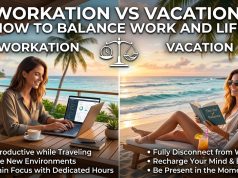
Workation vs Vacation Benefits depend on whether your priority is productivity, recovery, flexibility, adventure, or meaningful time away from everyday responsibilities.
Modern travel is no longer limited to the traditional idea of taking time off, flying somewhere, staying in a hotel, and returning home after a few days. Remote work, flexible schedules, digital tools, freelance careers, and hybrid employment have created a new category of travel where people can explore a destination while continuing professional responsibilities.
That shift creates an important question: should you take a workation or a true vacation?
Workation vs Vacation Benefits become easiest to understand when you stop thinking of both options as competing versions of the same trip. They solve different problems. A workation allows you to change your environment while remaining connected to work. A vacation deliberately creates distance from professional responsibilities so your attention can move toward rest, relationships, exploration, or personal recovery.
Workation vs Vacation Benefits can therefore differ dramatically depending on your current life stage. Someone launching a business may appreciate being able to spend several weeks in another city without completely pausing work. Someone experiencing mental fatigue may need uninterrupted time away from email, notifications, meetings, and deadlines.
Workation vs Vacation Benefits also depend on how you personally recover. Some people feel energized by working from a beautiful location and exploring before or after their workday. Others never fully relax when their laptop is nearby.
Workation vs Vacation Benefits are ultimately about matching the travel format to the result you actually want. If you return home having answered emails beside a beach but never mentally disconnected, you may have changed your location without changing your state of mind. On the other hand, if a short workation gives you renewed creativity, stronger motivation, and a memorable cultural experience, it may be exactly what you need.
Understanding the Core Difference
A vacation is traditionally built around interruption. You pause regular work, create distance from your normal environment, and dedicate your time to activities that support rest, entertainment, relationships, exploration, or personal interests.
A workation is built around integration. You take some or all of your normal responsibilities with you while changing the environment in which you perform them.
Workation vs Vacation Benefits are easier to compare when you look at the core objective of each format.
| Factor | Workation | Vacation |
|---|---|---|
| Primary Goal | Work + travel | Rest + travel |
| Work Commitments | Continue | Pause |
| Daily Structure | Fixed work blocks | Flexible |
| Recovery Potential | Moderate | High |
| Productivity Potential | Potentially high | Low by design |
| Exploration Time | Before/after work | Most of the day |
| Digital Connection | Usually necessary | Can be minimized |
| Length | Often longer | Often shorter |
| Best For | Remote professionals | People needing true downtime |
Workation vs Vacation Benefits become more obvious when the question changes from “Which is better?” to “What do I need right now?”
If you need creative stimulation, a temporary change of scenery, and the flexibility to work remotely, a workation may fit.
If you are exhausted, distracted, emotionally overloaded, or desperately overdue for uninterrupted personal time, a vacation may provide greater value.
What Exactly Is a Workation?
A workation combines work and travel in a planned way. You might spend two weeks in another city, work normal business hours from a hotel or apartment, and use mornings, evenings, weekends, or days off to explore.
Workation vs Vacation Benefits become particularly relevant for professionals who have location-independent jobs. Software developers, designers, marketers, writers, consultants, entrepreneurs, project managers, and many remote employees can potentially work from destinations that offer reliable internet and suitable workspaces.
A successful workation is not simply “bringing your laptop on holiday.”
It requires structure.
You need a workspace, a dependable internet connection, realistic working hours, appropriate time-zone planning, and an understanding of how much energy remains after work.
Workation vs Vacation Benefits can be strongest when the trip is long enough to settle into a rhythm. Instead of spending an entire weekend trying to recover from travel and then rushing home, you may stay for two or three weeks and experience the destination more slowly.
A workation can also reduce the feeling that you need to see everything immediately. Because you are staying longer, you can explore one neighborhood at a time rather than trying to complete a typical tourist checklist.
What Exactly Is a Vacation?
A vacation creates intentional separation between professional responsibilities and personal time.
You might take three days, one week, or an extended break. During that period, the expectation is that your work obligations have been handed over, paused, or minimized.
Workation vs Vacation Benefits are especially different when recovery is the main goal. A vacation gives your mind permission to stop thinking about performance, deadlines, meetings, targets, and unfinished tasks.
A true vacation also changes how you experience time. Instead of asking whether you have enough time to finish something before your next meeting, you can decide whether you want to sleep longer, walk farther, stay for another meal, or explore an unexpected place.
For people who spend most of their week in front of screens, this mental separation can be extremely valuable.
The Biggest Advantage of a Workation: Longer Travel

One of the most attractive Workation vs Vacation Benefits is the possibility of staying longer.
Traditional vacations can become expensive because travelers often need to fit flights, accommodation, sightseeing, and rest into a narrow time window. A longer workation spreads those experiences over more days.
Imagine spending fourteen days in a destination rather than four.
You can work during weekdays, explore before or after work, use weekends for major adventures, and reserve some evenings for slow local experiences.
Workation vs Vacation Benefits become particularly noticeable for travelers who dislike rushed itineraries. You do not need to visit six attractions in one day because you will still be there tomorrow.
Longer stays can also provide deeper cultural exposure. You might learn the best local café, return to the same neighborhood market, recognize familiar faces, discover a local walking route, or develop a routine that feels more natural than a typical tourist schedule.
For people who enjoy independent travel, this can produce a stronger sense of place.
The Biggest Advantage of a Vacation: Mental Separation
The strongest Workation vs Vacation Benefits argument for vacation appears when your mind needs complete disconnection.
Working while traveling can create a strange psychological situation. Your body is in a new place, but your attention may remain trapped inside the same inbox, project dashboard, client conversation, or company chat.
A vacation removes that conflict.
When you do not have to answer work messages, you can concentrate completely on where you are.
That distinction is particularly important for people who struggle to stop working even when nobody explicitly asks them to.
A true vacation can create a hard boundary: work ends here, and personal time begins.
Workation vs Vacation Benefits therefore should never be measured only in terms of how much you can accomplish. Recovery has its own value, and sometimes the most productive decision is to stop producing anything for a while.
Productivity and Creativity: Can Travel Improve Your Work?
A new environment can sometimes improve creativity.
Different architecture, food, languages, landscapes, people, and cultural experiences can introduce new perspectives. A marketer might return with campaign ideas. A writer may find new stories. A designer may notice color combinations and visual patterns that would never stand out in a familiar office.
Workation vs Vacation Benefits can therefore include creative stimulation.
However, the environment alone does not guarantee productivity.
You may also become distracted by unfamiliar surroundings, irregular sleep, long excursions, noisy accommodation, poor internet, or constant social activity.
The key is intentional scheduling.
A workation should define when you work and when you explore.
Without clear boundaries, the entire day can become fragmented.
You may check email during breakfast, attend meetings while thinking about sightseeing, answer messages from a café, and finally open your laptop again at night because you did not finish enough during the day.
That is not an effective workation.
Workation vs Vacation Benefits become stronger when work remains contained within predictable blocks.
A Simple Workation Schedule
A practical workation does not need to resemble your normal office routine perfectly, but it should have enough structure to protect both productivity and personal time.
Example Weekday
| Time | Activity |
|---|---|
| 7:00–8:00 | Breakfast and local walk |
| 8:00–12:00 | Focused work |
| 12:00–1:00 | Lunch |
| 1:00–4:00 | Meetings and lighter work |
| 4:00–5:00 | Break |
| 5:00–8:00 | Exploration or activity |
| 8:00 onward | Dinner and personal time |
Workation vs Vacation Benefits become easier to realize when your workday has a clear ending.
Do not let the laptop quietly expand into every free hour.
The purpose of the trip is not to recreate your home office with a different background.
Financial Benefits of a Workation
Money is another major factor in the comparison.
At first glance, a workation can appear more expensive because you are paying for accommodation while continuing to work. But the longer-stay model can sometimes make travel more financially efficient.
Longer accommodation bookings may offer better nightly rates. You may also spend less on sightseeing because you are not trying to fill every hour with paid activities.
Workation vs Vacation Benefits can include lower daily pressure to eat at tourist-focused restaurants. With a longer stay, you can shop at supermarkets, cook some meals, use public transportation, and discover local options.
A traditional vacation can create a “maximize every day” mindset.
That often leads to expensive guided activities, multiple restaurant meals, airport transfers, attraction tickets, and short-distance transportation.
A workation may slow that pattern down.
You can work most weekdays and choose only a few major experiences.
However, workation expenses can also accumulate through coworking fees, better accommodation, stronger internet packages, ergonomic equipment, and longer stays.
The right comparison is not “Which is cheaper?” but “Which gives me the best value for my actual objective?”
The Hidden Cost of a Workation
There is another cost that does not appear on a credit-card statement: attention.
Workation vs Vacation Benefits can decline quickly when work consumes the best parts of the travel experience.
Suppose you are staying near a beautiful coastline, but your meetings occupy the entire afternoon. You may technically be in a stunning destination, yet the experience you wanted remains inaccessible.
Similarly, if you spend evenings responding to messages because time-zone differences make your colleagues active while you are finishing dinner, you may never feel fully present.
A workation therefore requires more than permission to work remotely.
It requires boundaries.
Ask your employer or clients about working hours, meeting expectations, response times, and communication windows before departure.
Who Should Choose a Workation?
A workation is often best suited to people who have genuine location flexibility.
Remote employees with output-based roles may find it easier than professionals whose responsibilities depend on physical presence.
Entrepreneurs and freelancers may also benefit because they can decide when and where work happens.
Workation vs Vacation Benefits are particularly attractive for people who enjoy routine. Some travelers become happier when they can maintain familiar working habits while exploring a new destination.
A workation may also suit people who prefer longer travel but cannot realistically take several weeks away from professional responsibilities.
However, the model can be a poor fit for someone whose work is already overwhelming.
If your workload is intense, your calendar is full of meetings, or you struggle to stop checking messages, adding travel may increase stress rather than reduce it.
Who Should Choose a Vacation?
A vacation is usually the better option when your central goal is recovery.
People coming out of demanding projects, high-pressure periods, emotionally exhausting circumstances, or long stretches of overwork often benefit more from true separation.
Workation vs Vacation Benefits should therefore be evaluated against your current mental state rather than your personality alone.
Ask yourself:
“Do I want a new environment, or do I want a break from responsibility?”
That single question can reveal a lot.
If the answer is responsibility, take a vacation.
If the answer is environment, a workation may be worth considering.
If the answer is both, you might need a hybrid model.
The Hybrid Option: Workation + Vacation
You do not necessarily have to choose one format for the entire trip.
A hybrid approach can combine the best parts of both.
For example, you might spend ten days at a destination, work remotely for the first six weekdays, then take the final four days completely off.
This structure creates continuity without sacrificing genuine downtime.
Workation vs Vacation Benefits can become especially balanced under this approach because the transition is gradual.
During the work portion, you maintain professional commitments.
During the vacation portion, you disconnect.
Example 10-Day Hybrid
| Days | Mode | Main Focus |
|---|---|---|
| 1–2 | Workation | Arrival and adjustment |
| 3–6 | Workation | Work + light exploration |
| 7 | Transition | Slow day |
| 8–10 | Vacation | Full relaxation and adventure |
This can be an excellent option for people who cannot take long leave but still need meaningful recovery time.
Choosing the Right Destination
Destination selection can determine whether a workation succeeds.
You need more than beautiful scenery.
Look for:
- Stable internet.
- Comfortable accommodation.
- Coworking options if needed.
- Reliable transportation.
- Useful time-zone alignment.
- Good food access.
- Quiet work environments.
- Safe neighborhoods.
- Activities available outside work hours.
Workation vs Vacation Benefits can change dramatically based on location.
A destination with breathtaking views but unreliable connectivity may be wonderful for a vacation and terrible for a workation.
A highly connected city may be ideal for work but less satisfying if you are desperately seeking solitude.
This is where personal travel style matters.
City Workations Versus Nature Workations

Urban destinations are often easier for workations because cafés, coworking spaces, transportation, business services, and reliable infrastructure are concentrated.
Nature destinations can provide stronger inspiration and relaxation but may require more careful planning.
A remote cabin overlooking mountains can sound like the perfect workation until the internet becomes unstable and the nearest grocery store is forty minutes away.
Workation vs Vacation Benefits therefore depend heavily on infrastructure.
If your work requires video meetings, choose reliability over aesthetics.
If your work is asynchronous and flexible, you may have more freedom to prioritize scenery.
The Role of Digital Detox
One of the central contradictions of a workation is that you are traveling while remaining digitally connected.
For some people, that is energizing.
For others, it prevents genuine rest.
That is why creating small periods of Digital Detox Travel can make a workation healthier. You might choose mornings without social media, an evening with your phone on silent, or a full half-day every weekend without email.
Workation vs Vacation Benefits improve when technology becomes a tool rather than the environment itself.
A vacation can go even further by allowing you to disconnect almost completely.
But even on vacation, many travelers remain psychologically attached to their phones.
The deeper question is whether technology is supporting the trip or controlling it.
Workation and Relationships
Traveling with a partner, family member, or friend adds another layer.
Workation vs Vacation Benefits can create tension when one person works while the other expects shared exploration.
Imagine a couple visiting a coastal destination. One person has meetings from 9 a.m. to 4 p.m., while the other wants to spend the entire day exploring.
Neither person is necessarily wrong.
They simply selected different experiences.
A successful shared workation requires explicit expectations.
Discuss:
- Working hours.
- Quiet hours.
- Shared activities.
- Personal time.
- Meals.
- Accommodation space.
- Weekend plans.
A vacation can be simpler because both travelers are generally available.
Travel Experiences That Work Well Around a Work Schedule
A workation does not mean you must give up adventure.
You simply need to select activities that fit your available windows.
Early-morning walks, sunset viewpoints, local food tours, museums near your accommodation, neighborhood exploration, short hikes, beach visits, and weekend day trips can all work well.
A Microadventure is another useful concept for workation travelers. Instead of waiting for a full free week to do something exciting, you can create small adventures within the time you already have.
For example, you might:
- Watch sunrise from a nearby viewpoint.
- Take a short trail after work.
- Explore a local market.
- Rent a bicycle for two hours.
- Visit a nearby coastal village.
- Take an evening photography walk.
- Try a new restaurant without planning ahead.
These experiences can make a workation feel like travel rather than relocation.
The Problem With “I Can Rest Later”
One of the most dangerous assumptions about workations is that rest will somehow happen automatically.
It usually does not.
If you keep adding work to the schedule, your free time disappears.
Workation vs Vacation Benefits are strongest when recovery is actively protected.
Do not assume that weekends will automatically be enough.
Do not assume that beautiful surroundings will automatically reduce stress.
Do not assume that being away from the office means your brain has stopped working.
Rest is a behavior, not a location.
How to Set Professional Boundaries
Before taking a workation, establish clear expectations with your employer, team, or clients.
Clarify:
- Your working hours.
- Your time zone.
- Meeting availability.
- Response-time expectations.
- Deadline responsibilities.
- Emergency communication.
- Any location or data-security requirements.
This matters because Workation vs Vacation Benefits depend partly on whether work remains predictable.
If every day includes unexpected tasks, your travel schedule will become unstable.
A well-designed workation should protect your professional reputation while also protecting your personal experience.
The Time-Zone Problem
Time zones can make or break a workation.
A destination only three hours away from your company’s main time zone may be easy.
A destination twelve hours away can turn daytime into your team’s night and your evening into their workday.
Workation vs Vacation Benefits are therefore heavily influenced by time-zone compatibility.
Before booking accommodation, map your expected work hours against local time.
Then consider what those hours mean for the actual travel experience.
If you must work from 5 p.m. to 1 a.m., are you realistically going to enjoy the destination?
Sometimes the answer is yes.
Often it is not.
Accommodation Matters More Than You Think
A beautiful room is not automatically a good workation room.
You need a proper chair, usable desk or table, sufficient outlets, stable Wi-Fi, reasonable noise levels, and enough separation between work and sleep.
Workation vs Vacation Benefits can disappear when your bed becomes your office.
Working from bed might feel comfortable for an hour, but it can blur the psychological distinction between work and rest.
Whenever possible, create a dedicated work zone.
Even in a small apartment, placing the laptop at one specific table can help create a mental boundary.
For vacations, none of this matters nearly as much.
Your accommodation can simply be comfortable, convenient, and enjoyable.
How Long Should a Workation Be?
There is no universal answer, but length changes the experience dramatically.
A three-day workation may not provide enough time to settle into the destination.
A two-week workation can create a sustainable routine.
A one-month stay may begin to resemble temporary living rather than traditional travel.
Workation vs Vacation Benefits often increase with length when accommodation becomes more affordable per night and your routine stabilizes.
However, longer does not always mean better.
A long workation with poor boundaries can simply prolong the feeling that you are never fully off work.
A shorter hybrid trip may deliver better results.
How Long Should a Vacation Be?
The ideal vacation length also depends on the traveler.
A long weekend can be enough for someone who wants a city reset.
A full week may be more suitable for deeper relaxation.
Two weeks can be worthwhile for long-haul travel where flights consume substantial time.
The key is leaving enough space for the body and mind to adjust.
Workation vs Vacation Benefits may favor vacation strongly when your travel destination requires significant recovery from travel itself.
There is little value in flying twelve hours, sleeping poorly, and then returning home exhausted because you tried to maximize every minute.
How to Decide With a Simple Decision Framework
You can make the decision easier by scoring your priorities.
Choose a Workation If:
- You genuinely enjoy working remotely.
- Your job allows location flexibility.
- You want a longer trip.
- You enjoy routine.
- You have predictable working hours.
- You are not severely burned out.
- Your destination has strong infrastructure.
- You want to combine work with exploration.
Choose a Vacation If:
- You feel mentally exhausted.
- You need complete separation.
- You want uninterrupted family time.
- Your work consumes too much attention.
- You want spontaneous full-day activities.
- You have not taken proper leave recently.
- You need a digital reset.
Workation vs Vacation Benefits become much clearer when you answer honestly rather than choosing based on what sounds exciting on social media.
Example: When a Workation Wins
Imagine a freelance designer who has no office requirement, works primarily asynchronously, and has a manageable workload.
They want to spend three weeks exploring a new country but cannot justify taking three full weeks off.
A workation could allow them to keep earning while experiencing a new environment.
They might work Monday through Friday mornings and use afternoons and weekends for exploration.
For that person, Workation vs Vacation Benefits may strongly favor the workation.
The travel becomes sustainable because the work requirement does not destroy the experience.
Example: When a Vacation Wins
Now imagine a project manager who has spent six months handling deadlines, meetings, escalations, and constant communication.
They are exhausted.
They book a beach destination but plan to take their laptop “just in case.”
Every morning they check Slack.
Every evening they answer email.
They attend two meetings during the trip.
Technically, they traveled.
Emotionally, they never left work.
In that situation, Workation vs Vacation Benefits strongly favor a real vacation.
The person does not need a new office.
They need recovery.
Examples of Different Traveler Types
The Entrepreneur
Often benefits from a workation, provided deadlines and workload are manageable.
The Burned-Out Employee
Usually benefits more from a true vacation.
The Digital Nomad
May prefer a longer workation because travel and work are already integrated into their lifestyle.
The Parent
May prefer a hybrid arrangement if school schedules, childcare, or family responsibilities limit uninterrupted travel.
The Creative Professional
May gain inspiration from a workation but still needs periodic full disconnection.
The Couple With Different Schedules
Can succeed with either option if expectations are discussed before booking.
Solo Travel and the Workation Decision

Solo travelers have an unusual advantage: they can design their schedule almost entirely around themselves.
They can work in the morning, explore at sunset, change neighborhoods, or spend an entire day offline without needing to coordinate with another person.
Workation vs Vacation Benefits can therefore be particularly attractive to independent travelers.
However, Solo Travel Hawaii can also make it easier to overwork because nobody is physically present to encourage you to close the laptop.
You may tell yourself that one more hour is harmless.
Then another hour passes.
This is where self-discipline matters.
A solo workation works best when your schedule is intentional and your workday has a hard stopping point.
Combining City and Nature
One of the smartest strategies is combining an urban workation base with short nature escapes.
You might stay in a well-connected city during weekdays and take weekend trips to mountains, beaches, forests, or smaller towns.
This allows you to enjoy infrastructure without sacrificing adventure.
Workation vs Vacation Benefits become more balanced when your trip offers both convenience and contrast.
You might spend Monday working from a café, Tuesday exploring a museum after work, Wednesday taking a neighborhood walk, and Saturday hiking outside the city.
The result can feel far richer than staying in one resort and working from the room every day.
When a Vacation Should Include a Work-Free Rule
Some travelers need an explicit rule: no work.
That can mean no laptop, no work apps, no professional email, and no expectation of response.
This is especially useful when work has become psychologically invasive.
Workation vs Vacation Benefits should not turn every vacation into a productivity exercise.
There is value in doing nothing useful.
Reading a novel, sitting by the water, walking without tracking distance, eating without checking your phone, or sleeping without an alarm can be more restorative than another carefully optimized itinerary.
The Role of Digital Detox on Vacation
Digital Detox Travel can be especially powerful during a vacation because the purpose of the trip is already disconnection.
You do not necessarily have to give up your phone completely.
Instead, create deliberate technology boundaries.
Turn off unnecessary notifications.
Remove work applications from your home screen.
Use your phone for navigation and photographs without continuously opening social media.
Choose specific times for communication.
The aim is not to reject technology.
The aim is to stop technology from occupying every empty space in your attention.
Workation vs Vacation for Long-Term Lifestyle Design
This discussion becomes more important when travel is not a one-time event.
Some people are building lifestyles where travel, work, and personal exploration coexist.
Others intentionally protect vacations as sacred periods of disconnection.
Neither lifestyle is automatically superior.
Workation vs Vacation Benefits depend on what role travel plays in your broader life.
If travel is part of your daily lifestyle, workations may feel natural.
If travel is an escape from your daily lifestyle, vacations may be more meaningful.
That distinction can help you understand what you actually want from travel.
Common Workation Mistakes
Mistake 1: Working Too Much
The destination becomes background scenery.
Mistake 2: Choosing Accommodation for Appearance
A beautiful room with terrible Wi-Fi is a poor work base.
Mistake 3: Ignoring Time Zones
Your evenings disappear into meetings.
Mistake 4: Scheduling Too Many Excursions
You become tired and less productive.
Mistake 5: Forgetting Real Rest
Every free moment becomes another opportunity to explore.
Mistake 6: Assuming Flexibility Means No Structure
Without boundaries, work can consume the entire day.
Mistake 7: Bringing Every Work Device
Extra equipment can increase both weight and psychological attachment to work.
Workation vs Vacation Benefits improve when you design the trip around sustainable habits rather than enthusiasm alone.
Common Vacation Mistakes
Vacations have their own problems.
Many people over-plan.
They book multiple tours, visit too many cities, wake up early every morning, stay out late, and return home needing another vacation.
Another common mistake is treating every meal and attraction as an optimization challenge.
A vacation is not a competition.
Workation vs Vacation Benefits are easier to evaluate when you remember that rest can look boring.
That is not failure.
Sometimes the best vacation day is simply a slow breakfast, a swim, an afternoon nap, and dinner somewhere nearby.
A Practical Budget Comparison
| Expense Category | Workation | Vacation |
|---|---|---|
| Accommodation | Longer stay | Shorter stay |
| Work Equipment | Potentially higher | Minimal |
| Coworking | Possible | Rare |
| Dining | More local/self-prepared | More restaurant-focused |
| Activities | Spread out | Often concentrated |
| Transportation | Often lower daily activity | Potentially higher |
| Digital Costs | Data/Wi-Fi important | Less important |
| Income | Usually continues | Usually paused |
Workation vs Vacation Benefits become financially meaningful when you calculate the entire experience rather than focusing on accommodation alone.
A workation may preserve income but require higher logistical planning.
A vacation may temporarily reduce income or use paid leave but provide stronger recovery.
The right answer depends on your employment structure and financial priorities.
What to Ask Yourself Before Booking
Before choosing either option, ask:
- Why do I want to travel?
- Am I trying to escape work or change my work environment?
- How tired am I right now?
- Can my job genuinely be performed remotely?
- What time zone will I be working in?
- How much free time will remain after work?
- Will I actually disconnect?
- Can I afford the trip comfortably?
- Am I traveling for myself or because everyone online is doing it?
- What do I want to feel when I return?
Workation vs Vacation Benefits become much easier to judge when the emotional objective is clear.
A 7-Day Workation Plan
| Day | Work | Travel |
|---|---|---|
| Monday | Full workday | Local evening walk |
| Tuesday | Full workday | Dinner exploration |
| Wednesday | Full workday | Short sunset activity |
| Thursday | Full workday | Cultural attraction |
| Friday | Lighter work | Evening experience |
| Saturday | No work | Full-day adventure |
| Sunday | No work | Slow recovery day |
This structure illustrates how workation travel can still contain meaningful experiences without pretending that every day is a vacation.
Workation vs Vacation Benefits are strongest when work and leisure occupy different parts of the day instead of competing for the same hours.
A 7-Day Vacation Plan
A vacation can follow a completely different rhythm.
| Day | Focus |
|---|---|
| Day 1 | Arrival and rest |
| Day 2 | Major attraction |
| Day 3 | Flexible exploration |
| Day 4 | Nature or adventure |
| Day 5 | Slow local experience |
| Day 6 | Personal favorite activity |
| Day 7 | Recovery and departure |
Notice the absence of work.
That is intentional.
A vacation gives you permission to use your day according to energy rather than professional obligations.
The Psychology Behind the Choice

Travel decisions are emotional.
A workation can satisfy the desire for novelty without requiring you to completely disconnect from your professional identity.
A vacation can satisfy the deeper desire to temporarily stop performing.
Workation vs Vacation Benefits therefore connect to identity as much as logistics.
People who strongly identify with productivity may find vacations uncomfortable at first.
They may feel guilty about resting.
People who value experiences above routines may find workations frustrating because the workday interrupts exploration.
Neither reaction is inherently correct.
The important thing is recognizing your own pattern.
Workation or Vacation: The Better Long-Term Strategy
For many people, the healthiest strategy is not choosing one permanently.
Instead, use each intentionally.
Take workations when you want longer travel without fully pausing your career.
Take vacations when you need genuine recovery.
Use hybrid trips when you want both.
Workation vs Vacation Benefits become much more useful as a planning framework rather than a competition.
You can even create a personal travel calendar where workations support exploration and vacations protect your recovery.
For example, a person might take several short workations throughout the year and reserve one longer vacation specifically for complete disconnection.
This creates balance.
Final Decision Matrix
| Your Situation | Better Choice |
|---|---|
| Need complete rest | Vacation |
| Need creative stimulation | Workation |
| Remote flexible job | Workation |
| Severe work fatigue | Vacation |
| Want extended travel | Workation |
| Want uninterrupted family time | Vacation |
| Need digital reset | Vacation |
| Want slower destination immersion | Workation |
| Need both work and rest | Hybrid |
| Enjoy structured routines | Workation |
| Want spontaneous full days | Vacation |
Workation vs Vacation Benefits ultimately depend on the purpose behind your trip.
Do not choose based only on destination.
Choose based on what you want the destination to do for you.
Conclusion
Workation and vacation serve different purposes, and the best choice depends on what you need most. A workation can extend travel, maintain income, inspire creativity, and create a slower connection with a destination when your job genuinely supports flexibility. A vacation offers something different: complete separation, deeper recovery, and freedom from professional expectations. The smartest travelers do not ask which option is universally better. They ask which experience fits their current energy, responsibilities, budget, and personal goals. Sometimes you need a new office with a better view; sometimes you need no office at all. Choose the format that allows you to return feeling more fulfilled, refreshed, and clear-headed.
Frequently Asked Questions (FAQ)
1. What is the main difference between a workation and a vacation?
A workation combines remote work with travel, while a vacation intentionally pauses professional responsibilities so the traveler can focus on rest, leisure, relationships, and exploration.
2. Is a workation actually relaxing?
It can be, but not automatically. A workation is relaxing when work hours are limited, predictable, and separated from personal time. Without boundaries, it can become stressful.
3. Is a workation cheaper than a vacation?
Not necessarily. A longer stay can reduce average accommodation and activity costs, and your income may continue, but you may spend more on workspace, internet, equipment, and extended accommodation.
4. Who benefits most from a workation?
Remote employees, freelancers, entrepreneurs, and location-independent professionals with predictable workloads often benefit most from workations.
5. Who should choose a vacation instead?
Anyone experiencing significant burnout, mental fatigue, intense work pressure, or a strong need for digital and psychological disconnection may benefit more from a true vacation.
6. How long should a workation last?
There is no universal ideal, but one to three weeks can work well because it gives travelers enough time to establish a routine without turning the trip into an indefinite relocation.
7. Can I combine a workation and vacation?
Yes. A hybrid trip can include several workdays followed by several completely work-free days. This is often an excellent compromise for people who want both extended travel and genuine recovery.
8. How do I stay productive during a workation?
Use defined working hours, choose reliable accommodation, create a dedicated workspace, limit unnecessary meetings, protect your sleep, and schedule exploration around your work rather than constantly mixing the two.
9. How can digital detox help during a workation?
Short technology-free periods can reduce mental overload. Try disconnecting from work and social media after work hours or taking a completely offline half-day each week.
10. Which is better overall: workation or vacation?
Neither is universally better. A workation is stronger for flexibility, long-term travel, routine, and creative stimulation. A vacation is stronger for recovery, disconnection, and uninterrupted personal time. The best option depends on your current needs.