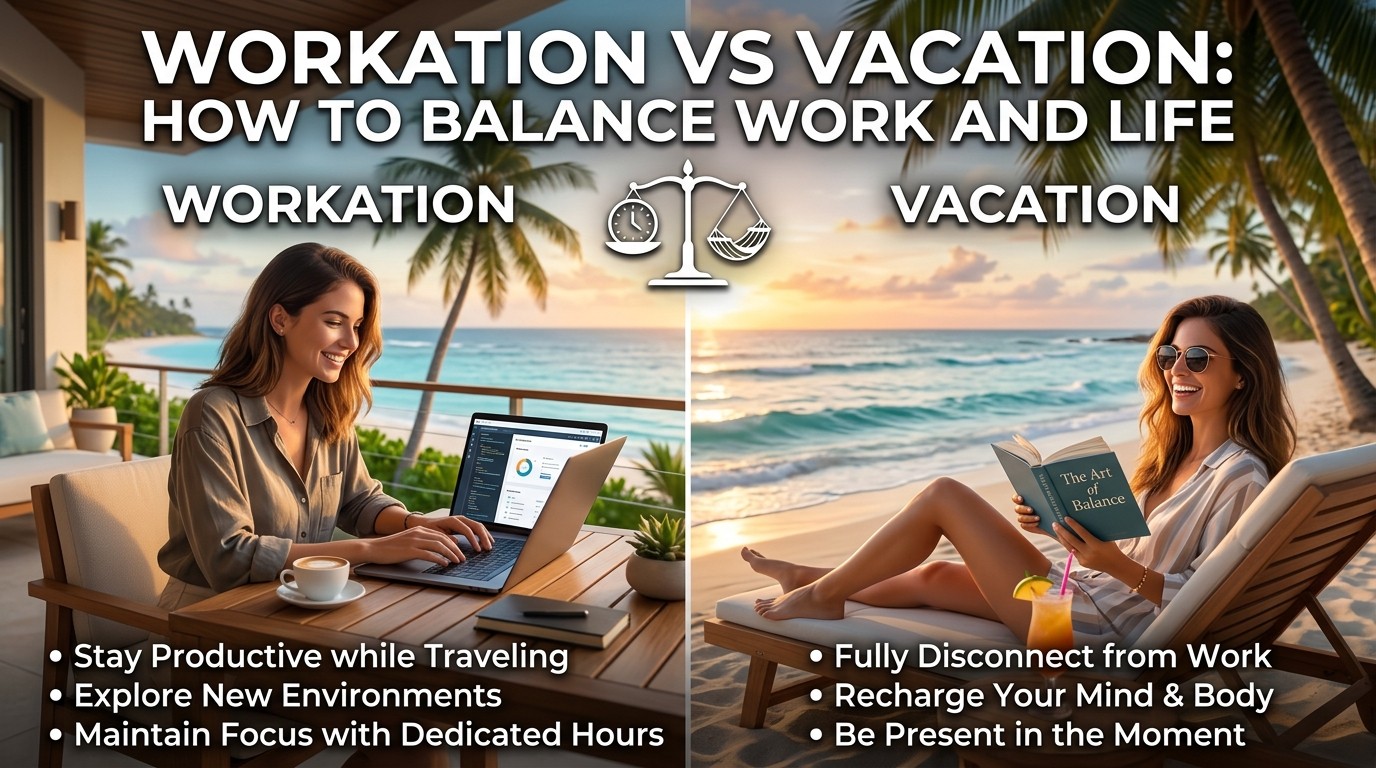
Workation vs Vacation is a practical decision about whether your trip should protect deep rest, preserve work momentum, or create a balanced mix of both without draining your energy.
Workation vs Vacation is more than a travel preference. It reflects how people want to live, work, recover, and move through modern life without feeling split between responsibility and rest. As remote work, flexible schedules, and digital tools have become normal, the old line between “working” and “traveling” has blurred. That is why Workation vs Vacation matters so much now. People are not only asking where they want to go. They are asking what kind of life rhythm they want while they are there.
Workation vs Vacation also touches a deeper emotional question: are you tired in a way that needs real recovery, or are you simply restless and needing a change of scene? That difference matters because the wrong choice can create guilt. If you travel on a vacation but keep checking work, the break may not feel like a break. If you choose a workation but secretly need rest, the trip may feel like another obligation in a nicer location. The best decision starts with honesty.
Workation vs Vacation is not about proving that one is better than the other. It is about choosing the structure that supports your actual needs. Sometimes that means a complete break. Sometimes it means a partial connection to work. Sometimes it means planning the trip in a way that gives you both, but with enough separation that each part still feels real.
Why the Choice Feels So Emotional
Workation vs Vacation often feels more emotional than it looks on paper because people attach identity to the way they travel. Some people feel proud when they can stay productive anywhere. Others feel proud when they can fully unplug. Because of that, the decision can become a hidden statement about who you think you are: disciplined, free, ambitious, tired, creative, or burnt out.
Workation vs Vacation also becomes emotionally loaded because modern workers are often surrounded by invisible pressure. Even when they are away, their phone still follows them. A message can arrive at any time. A deadline can still exist. A thought about unfinished work can interrupt dinner, the beach, or a train ride. That is why the choice needs a structure that protects the mind as much as the schedule.
If you choose carefully, Workation vs Vacation becomes a tool for balance instead of another source of guilt. The goal is not to travel in the most impressive way. The goal is to return home feeling like your life gained something useful.
The Core Difference Between the Two

At the simplest level, Workation vs Vacation is the difference between partial connection and intentional disconnection. A vacation is usually built around stepping away from work. A workation keeps a part of work alive while you are away. That seems like a small difference, but it changes your daily rhythm, your stress level, your budget, and even the way you experience the destination.
A vacation tries to create enough distance that your nervous system can settle. A workation tries to create enough flexibility that your responsibilities do not stop your movement. Workation vs Vacation therefore becomes a question of which need is stronger right now: recovery or continuity.
That difference matters because the brain responds differently to each mode. When you are fully off, the mind can slowly loosen its grip on tasks. When you are partially on, the mind remains alert, but it can still benefit from scenery, fresh air, and a new environment. The danger is choosing one mode while expecting the emotional benefits of the other.
What People Actually Need
Most people do not choose between Workation vs Vacation based on logic alone. They choose based on what they hope the trip will fix. Some want relief from stress. Some want better focus. Some want time with family. Some want to travel without pausing income. Some want to rest without feeling disconnected from their goals. The right choice depends on the dominant need, not on what sounds trendy.
If your mind is overloaded, sleep is poor, and every extra task feels heavy, a vacation usually makes more sense. If your work is flexible, your stress is moderate, and a change of scenery would improve your concentration, a workation may be enough. Workation vs Vacation becomes easier to judge when you stop asking which one looks smarter and start asking which one would make your life better after the trip is over.
There is also a practical side. Some people need to finish projects without losing momentum. Others need to step away completely because even a light work connection would keep their mind tense. The better choice is the one that reduces friction rather than adding a new kind of pressure.
Questions That Clarify the Decision
Before deciding on Workation vs Vacation, ask yourself a few honest questions. Do I need a break from performance, or do I need a change in environment? Can I realistically separate work hours from personal hours? Will this trip restore me, or will it only delay the burnout? Do I have enough control over my schedule to make a partial-work trip feel healthy?
Workation vs Vacation becomes much clearer when those questions are answered without self-promotion. It is easy to imagine that you can work and relax at the same time. It is harder to admit that you may need one more than the other. The best travel choices are not the ones that look impressive. They are the ones that fit the season you are in.
You may also want to ask whether your trip needs to produce something specific. If you need deep rest, then a full vacation protects that goal. If you need progress on a project, then a workation can help you move without canceling the trip. If you need both, the answer becomes more nuanced and requires sharper boundaries.
Boundaries Are the Real Difference Maker
Workation vs Vacation is not just a destination choice. It is a boundary choice. Without boundaries, work bleeds into everything and rest becomes shallow. With boundaries, the same trip can feel balanced, predictable, and genuinely restorative.
For a workation, the main boundary is time. You need to know when work begins, when it ends, and what counts as urgent. For a vacation, the main boundary is availability. You need to know whether you will check messages at all, whether you will answer only emergencies, or whether you will step away completely. Workation vs Vacation becomes easier when these rules are set before the trip begins.
Boundaries also apply to the physical environment. A quiet corner for work, a comfortable place for sleep, and a different setting for leisure can all help the brain switch modes more smoothly. Even small signals matter. If the laptop stays open on the bed, the brain struggles to rest. If the laptop is packed away after work, rest becomes easier to trust.
A strong boundary is not a punishment. It is a kind of kindness. It tells the mind what to expect and protects the part of the trip that matters most.
How Location Shapes the Experience
Location plays a huge role in Workation vs Vacation because the same schedule feels different in different places. A lively city hotel, a beach apartment, a quiet countryside stay, and a mountain lodge all create different mental climates. The environment can either support your purpose or undermine it.
For a workation, you often want reliable internet, a calm workspace, easy food access, and enough comfort that work feels manageable. For a vacation, you may want a place that naturally encourages rest and fewer responsibilities. Workation vs Vacation becomes easier when the location is chosen for the specific mode you want to protect.
The wrong location can quietly drain the trip. If you choose a noisy place for recovery, the body never fully relaxes. If you choose an isolated place for work, the work side may become frustrating or inefficient. The best choice is the one that makes your intended rhythm feel natural.
This is also where travel style begins to matter. Some travelers compare their choices through Eco Travel vs Traditional Travel because they want a trip that reflects their values as well as their practical needs. Others look at Top Best Eco Friendly Travel Destinations when they want a slower, more mindful experience. Those comparisons can be helpful because they remind you that travel is never just about distance. It is also about pace, comfort, and intention.
Productivity Without Turning the Trip Into an Office

Workation vs Vacation becomes especially interesting when productivity enters the conversation. A workation can be genuinely helpful if the work is carefully chosen and the environment supports focus. It can give you enough change to feel refreshed without losing progress on important tasks.
The key is to choose the right work. A workation is better suited to contained tasks than to chaotic, highly collaborative projects. Simple writing, planning, editing, admin work, and focused solo tasks often fit well. The trip becomes much harder when you expect yourself to do complex work that needs constant coordination or long uninterrupted meetings.
Workation vs Vacation also matters because of the trap of overworking. People sometimes think they need to “make the trip worth it” by finishing more than usual. That can quickly create a scenic version of burnout. A better measure is whether you made meaningful progress while still enjoying the trip. The goal is balance, not performance theater.
A workation should feel like a support system for your work, not a test of how much you can tolerate while traveling. If the work side grows too large, the trip loses its restorative value. If the rest side grows too large, the work side may feel neglected. The right middle path is the one that protects both.
Rest That Actually Feels Real
Workation vs Vacation becomes most useful when you think carefully about rest. Rest is not only about lying down or sleeping longer. It is about giving the brain permission to stop being responsible for a while. A vacation is built for that. A workation is not always built for that, but it can still include real rest if the structure is strong.
The problem many travelers face is guilt. They answer emails while eating. They think about deadlines while sightseeing. They feel pressure to stay available even when the point of the trip was to recover. Workation vs Vacation should help reduce that pressure by making the plan clear from the beginning.
If you choose a workation, it helps to protect actual offline blocks. That can mean a no-email evening, a fully offline lunch, or a day with only minimal work. If you choose a vacation, it helps to protect it more fully by stepping away from constant check-ins. Either way, rest has to be real or the trip will not feel balanced.
A useful test is to ask whether your body feels more settled after the first day or two. If it does, the structure is working. If it does not, the trip may be too connected, too noisy, or too demanding to serve its purpose.
Money and Value
Workation vs Vacation also has a financial side. Travel costs money, and time is limited. A workation can feel efficient because it allows you to keep producing while you travel. A vacation can feel expensive because it pauses work. But efficiency is only useful if it supports the goal you actually care about.
If your main goal is rest, then cheaper is not always better. A quieter room, a better bed, a stronger internet connection, or a more convenient location may be worth the extra cost. If your main goal is continuity, then spending more for reliable work conditions may be wise. Workation vs Vacation becomes more financially intelligent when spending follows purpose rather than habit.
Some travelers reduce transport costs with Travel Hacking Miles, which can make either type of trip more reachable. That can be useful, but the real question is still the same: what kind of trip will help you most right now? A cheaper trip that leaves you exhausted is not actually a better deal.
The smartest budget is the one that matches the trip’s emotional job. When money is aligned with purpose, the trip feels less stressful and more satisfying.
Social Pressure and Expectations
Workation vs Vacation is not only private. Other people have opinions too. Some think a proper trip means complete disconnection. Some think working while traveling is impressive. Some think any travel should be fully relaxing. Those opinions can create pressure if you let them define your choice.
The best way to handle that is to communicate clearly. If you are on a workation, tell people when you are available and when you are not. If you are on a vacation, tell them that you will be offline or only lightly reachable. Workation vs Vacation becomes easier when the people around you know the rules before the trip begins.
This matters because confusion creates emotional drag. If people expect fast replies and you are trying to rest, the vacation feels broken. If people expect you to disappear and you are trying to work, the workation feels stressful. Clear expectations protect both sides.
You do not need to justify your trip to everyone. You only need to build a trip that serves your actual life. That is where balance becomes real.
Health, Sleep, and Mental Clarity
Workation vs Vacation is heavily influenced by sleep, because sleep decides how clear and stable you feel. Poor sleep can make a beautiful trip feel heavy. Good sleep can make even a simple location feel restorative. If you are planning either kind of trip, sleep should be part of the decision.
A vacation usually supports sleep more easily because the mind is less likely to keep returning to work. A workation can still support sleep, but only if the schedule is structured and the evenings are protected. Workation vs Vacation should therefore consider not just the daytime plan, but the nighttime recovery plan too.
Mental clarity also matters. If you are already overloaded, then even a small amount of work can feel too loud. If your mind is calm but uninspired, a change of setting can help. The trip should lower the mental noise, not increase it. If it does the opposite, the structure needs to be adjusted.
A healthier trip usually includes steady mornings, predictable routines, and enough slack that you do not have to keep reacting to everything. That is how the body and mind begin to trust the trip.
When a Full Vacation Is the Better Choice
Sometimes Workation vs Vacation is not a difficult choice at all. A full vacation is simply the better answer. That is especially true when you are exhausted, grieving, emotionally overloaded, or unable to relax without guilt. In those cases, keeping work alive may only extend the pressure.
A vacation can give you what a workation cannot: a clean stop. That clean stop is often what the nervous system needs when it has been running too long. Workation vs Vacation should never become a way to avoid admitting that you need a real break. Sometimes the healthiest choice is the one that looks less efficient.
If you notice that even a small amount of work during the trip makes you tense, then your system is probably asking for deeper rest. A vacation may not fix everything, but it can create the space needed for recovery to begin.
When a Workation Is the Better Choice
There are also times when Workation vs Vacation clearly favors the workation. If your workload is flexible, your energy is stable, and your destination would help you focus or feel more creative, a workation can be very effective. It can keep momentum going while giving you the psychological lift of a new environment.
This tends to work best for remote workers, freelancers, founders, creators, and anyone whose work can be organized into clear blocks. The trip gives them a change of scene without forcing them to stop everything. Workation vs Vacation becomes useful here because it protects continuity without demanding full availability.
A successful workation feels like life with better scenery, not like an office with a different address. That distinction matters a lot. If the trip becomes too work-heavy, it stops feeling like travel. If it becomes too leisure-heavy, the work side can suffer. The best workation holds both sides gently.
Choosing the Right Structure for Your Season

Your season of life should matter more than any trend. Workation vs Vacation is not a permanent identity choice. It is a decision for this month, this quarter, or this particular trip. That is why the same person may need a vacation now and a workation later.
If you are in a recovery period, a vacation may protect your health. If you are in a creative or flexible period, a workation may support your momentum. If you are in a high-pressure period, you may need neither and should simply delay the trip. Workation vs Vacation becomes simpler when you stop treating it like a personality test and start treating it like practical planning.
The right answer can change as your responsibilities change. That flexibility is not inconsistency. It is wisdom.
A Practical Decision Table
| What You Need Most | Better Choice | Why |
|---|---|---|
| Deep recovery | Vacation | Protects rest and lowers pressure |
| Continued progress | Workation | Keeps work moving without staying home |
| Burnout relief | Vacation | Reduces mental and emotional load |
| Creative momentum | Workation | New environment can improve ideas |
| Full disconnection | Vacation | Clears work noise more completely |
| Partial flexibility | Workation | Supports both work and travel |
How to Make Either Choice Work Better
Workation vs Vacation becomes easier when you decide the purpose first, then build the trip around it. If the purpose is rest, protect rest from work creep. If the purpose is productivity, protect work from distraction. If the purpose is both, make sure one side does not silently consume the other.
You should also think about the physical setup. A good chair, reliable internet, a quiet room, and a realistic daily rhythm can make a workation much more sustainable. For a vacation, the setup should make it easy to stop thinking about work. The environment should support the mode you chose.
Some travelers choose a format that feels more guided and structured because they want less uncertainty, which is why they may gravitate toward Overseas Adventure Travel. The underlying lesson is useful here: structure can make a trip calmer. Workation vs Vacation works best when the amount of structure matches the kind of energy you actually have.
Common Mistakes to Avoid
One of the biggest mistakes in Workation vs Vacation is expecting the trip to do too much. People want productivity, deep rest, emotional healing, family time, and inspiration all at once. That creates pressure instead of balance.
Another mistake is choosing a workation but not setting boundaries. Without time limits, the work expands and the “travel” part disappears. A different mistake is choosing a vacation but secretly staying mentally attached to work. That prevents the mind from actually recovering.
A final mistake is letting the destination decide the trip entirely. Beautiful places are wonderful, but the right trip is the one that matches your current needs. Workation vs Vacation should be a practical decision, not a performance of taste.
Final Reflection
The real value of Workation vs Vacation is that it forces you to be honest about what you need from a trip. Some people need a break from output. Some need a fresh setting to keep going. Some need both, but in a carefully structured way. When you understand the difference, travel becomes less stressful and more intentional.
You do not have to choose the most impressive option. You only need to choose the one that helps you return in better shape than you left. That is the heart of balance. And that is why Workation vs Vacation is such a useful question in the first place.
Conclusion
Workation vs Vacation is really about choosing the right relationship between work, rest, and identity. A vacation gives you a cleaner break, which is often the healthier option when stress, burnout, or emotional overload are already high. A workation gives you flexibility, which can be useful when your workload is manageable and a new environment can sharpen your focus without draining you. The best choice is the one that protects your energy and supports your purpose. When you plan the trip around your real needs instead of around pressure or image, travel becomes more than a pause. It becomes a tool for living better.
Frequently Asked Questions (FAQ)
1. What is the main difference between a workation and a vacation?
A vacation is meant for disconnection and recovery, while a workation keeps some work active during the trip.
2. Is a workation good for everyone?
No. Workation vs Vacation depends on your workload, energy, and ability to keep boundaries clear.
3. How do I know if I need rest or productivity?
Ask whether your biggest need is recovery, progress, or both. Your answer usually points to the right choice.
4. What is the biggest mistake people make?
The biggest mistake is letting the trip become neither real work nor real rest.
5. Can a workation reduce burnout?
It can help if your workload is flexible and the environment is supportive, but it cannot replace real rest when you are already exhausted.
6. How do I avoid guilt on a vacation?
Set clear availability rules before you leave and allow yourself to be offline without checking work constantly.
7. How do I make a workation more effective?
Use clear work blocks, protect offline time, and choose a location with good comfort and reliable connectivity.
8. Does travel style matter in the decision?
Yes. The destination, pace, and structure of the trip all shape whether Workation vs Vacation fits better.
9. Should I budget differently for each option?
Yes. Spend on rest and comfort for a vacation, or on connectivity and workspace quality for a workation.
10. Can the right choice change over time?
Absolutely. Workation vs Vacation is not permanent. The better choice can change with your season, stress level, and responsibilities.